Kitchen diary
Inside Our Kitchen: What "Handmade" Actually Means
"Handmade" gets thrown around so much at farmers markets that it's starting to mean nothing. So here's a plain description of what it means at our shop on Pleasant Avenue: the numbers, the equipment, the failure rate, and the two days a lollipop spends in our care before it reaches a jar.
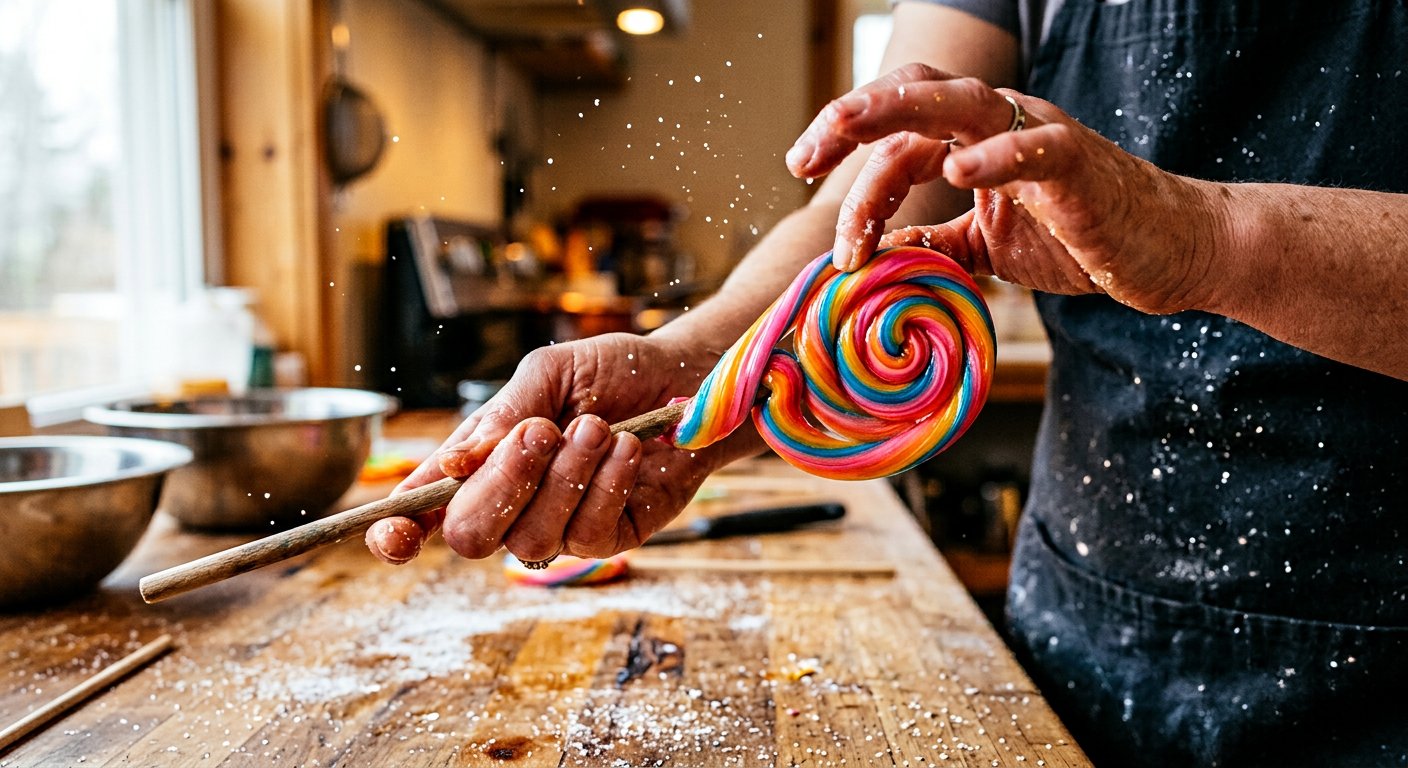
The equipment
Two copper sugar pans, one gas range, one marble slab, a handful of wooden hooks, brushes in every size from toothpick to index finger, an assortment of molds for the geometric shapes, and a thermometer we trust more than the manufacturer. That's most of it. There is no machine that pours, pulls, spirals, paints, wraps or seals anything. If you watched a batch being made, you'd be watching two people and a pan of very hot sugar.
The batch size
Between forty and eighty lollipops per batch, depending on the shape. Honeycomb Hexagons run bigger because the mold does part of the work; Nebula Pops run smaller because every one of them gets hand-dusted with shimmer. A productive day is three batches. A good day is sometimes two.
That's the real meaning of "small batch": not a marketing synonym for "premium," but a production limit that shapes everything else — the flavors we can offer, the runs that sell out, the waitlists, the prices.
The failure rate
Roughly one in ten pieces doesn't make it out of quality check. Spiral collapses, a painted border that bled, shimmer applied while the sugar was still too warm, a caramel square with a rustic corner. Those go into a bowl that has been, at various points, called the failure bowl, the tasting bowl, and — on good days — lunch.
Every failure gets a line in the notebook: what happened, what temperature the sugar was, what the humidity was doing. That notebook is the reason our repeat batches get more consistent and our new batches get less wild.
"The batch that teaches you something costs about forty pops. The batch that doesn't teach you anything is the one we should be worried about."
The time math
Here's an honest breakdown for one batch of Nebula Pops: about twenty minutes of cooking, forty to fifty minutes of swirling and dusting while the sugar cooperates, two days of resting, half an hour of wrapping, and about ten minutes of staring at the finished jar feeling relieved. The calendar says two days. The calendar is optimistic.
For the caramels, add a week of resting and a day of hand-cutting, because a square with an honest edge looks better than a square cut by a machine and tastes like it was made by someone who cared.
What we can't control
Humidity is the invisible partner in the kitchen. A July afternoon in Minnesota turns pulled sugar into a reluctant thing, and the spirals come out softer and slower than we want. Winter air does the opposite, drying things too fast and cracking the finish. Experienced candymakers know this; we're still learning it, which is why our summer batches lean toward caramels and our winter batches lean toward lollipops.
Why we don't scale it
People ask, every month, about wholesale volume or a bigger kitchen or an automated puller. The math usually works. What doesn't work is the part where the spirals stop being slightly different and start being identical — and the part where two people stop standing at the table arguing about whether the mango side needs more tart.
You can call that romance. We call it the product. Here's more on why we chose it.